What Is Fado?
Fado means fate. One voice, two guitars, songs about loss and the sea — what to listen for, who Amália Rodrigues was, and why the guitar sounds like that.
Fado means fate. The word comes from the Latin fatum, and once you know that, the music explains itself: the songs are about things that have already happened and cannot be changed. Emigration. The sea taking people. A city that is no longer the one you grew up in. Love that is over.
It is not sad music exactly. It is music about the fact of loss, which is a different and more bearable thing.
What is actually on the stage
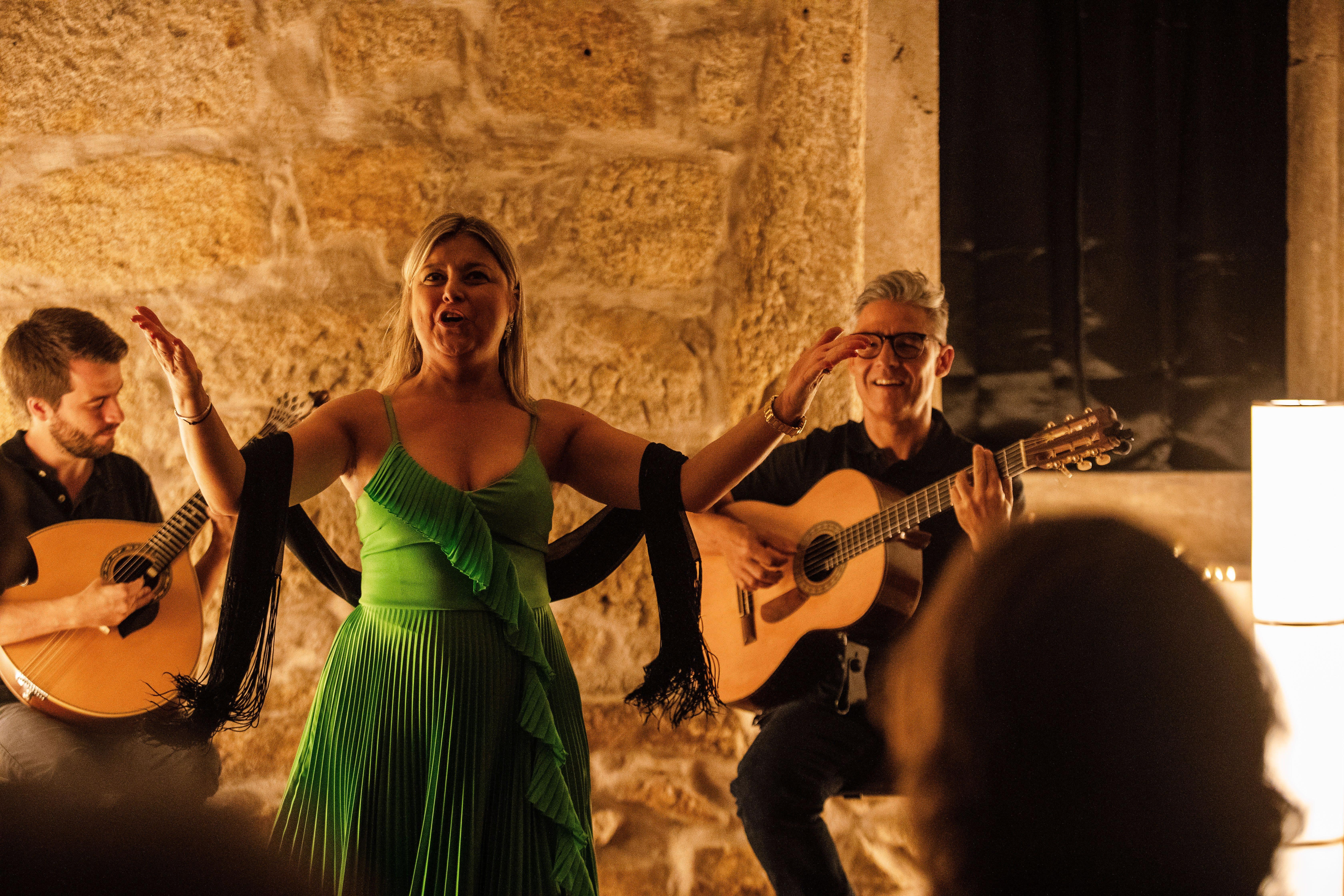
Three people, usually.
The singer — the fadista — stands still. There is no choreography, no gesturing, no working the room. The stillness is deliberate and it concentrates everything into the voice. Traditionally a fadista performing in the Lisbon style wears black, and a black shawl is the image most people carry of Amália.
The guitarra portuguesa carries the countermelody and it is the sound you will remember. It is a pear-shaped twelve-string with a bright, weeping, bell-like tone quite unlike a Spanish guitar, tuned in courses of paired strings and played with fingerpicks. It answers the singer line by line, almost conversationally.
The viola — a classical guitar in ordinary terms — holds the harmony and the pulse underneath. Sometimes there is a bass guitar as well.
That is the entire apparatus. No percussion, no keyboard, nothing amplified in spirit even when a microphone is present.
The two traditions
Fado was inscribed by UNESCO in 2011 as “Fado, urban popular song of Portugal”, and it exists in two recognised forms.
Lisbon fado is the one you are almost certainly going to hear. It emerged in the nineteenth-century working-class districts — Alfama, Mouraria — sung by women and men, and it is the tradition that went international.
Coimbra fado belongs to the university. It is sung almost exclusively by men, historically in the students’ black academic capes, with the guitarra tuned lower and a technique built for performing outdoors. It leans towards serenade rather than lament.
Porto venues typically programme both, which is a fair way to hear the difference in one sitting — one Porto house describes its programme as exactly that, running from traditional through Amália to contemporary. More on why Porto is not itself a third tradition in Porto vs Lisbon.
Amália
Amália Rodrigues (1920–1999) is the most famous fado singer there has ever been, and the gap between her and second place is not close. She took fado out of Lisbon’s back rooms and onto international stages across the middle of the twentieth century, recorded prolifically, and effectively defined what the world understands the music to be. In Portugal she is referred to simply as Amália.
Her repertoire is still standard programming, in Porto as everywhere else. If a song makes the room go completely still, there is a reasonable chance it is one of hers.
Saudade, and why nobody translates it
Every article about fado reaches for saudade and then admits it does not translate. That is correct, and the honest gloss is something like: the presence of an absence. A longing for something or someone gone, which is not simply sadness because there is a kind of pleasure in holding it.
It is the emotional subject of most of the repertoire. You do not need the word to feel what the singer is doing.
What to listen for, if it is your first time
The dynamics. A fadista will drop to almost nothing mid-line and then open up. That collapse and return is the technique, and it is why the room has to be silent.
The conversation between voice and guitarra. They are not accompanying each other so much as answering. Once you hear it you cannot unhear it.
The endings. Fado songs tend to end abruptly rather than fading — a hard stop into silence, then applause.
Will you understand it?
Not the words. It matters remarkably little. Several Porto venues introduce each song in English before performing it, and one includes an audio guide, so you go in knowing what the song is about — which is genuinely all the context required.
Audiences who speak no Portuguese routinely describe being moved by fado, and that is not politeness. The information is in the voice.
Book a Porto Fado Show
$23 for the live show and a glass of port, rated 4.8 by nearly 7,000 people. Rooms are small and evening slots sell out, especially from May to September. Instant confirmation, mobile ticket, free cancellation up to 24 hours before.
Check Availability & Book